
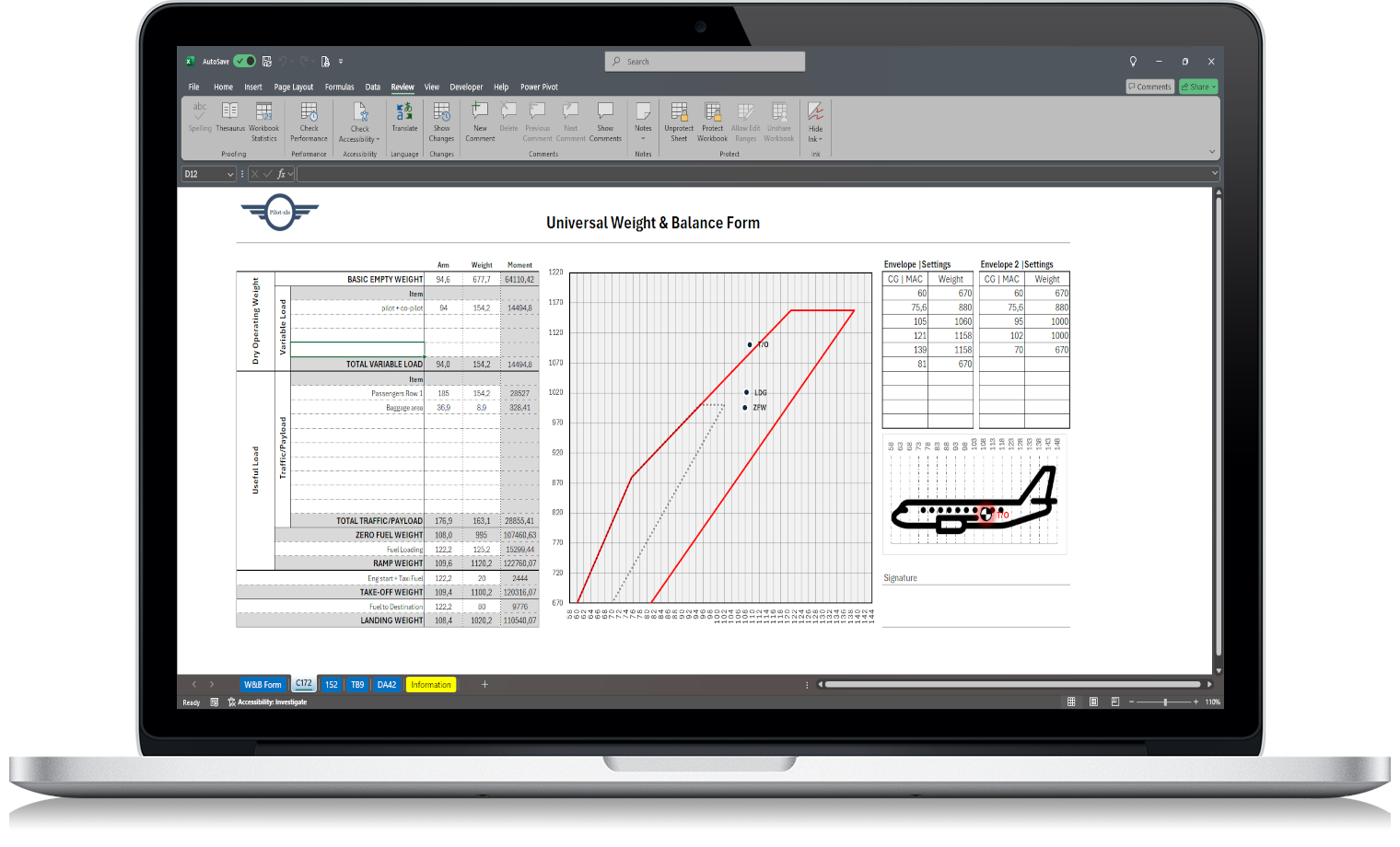
Accurate Weight and Balance Excel Pilots calculations are essential for every safe flight. This weight and balance Excel tool was built specifically for pilots operating under EASA and FAA regulations.
What Is Weight and Balance Excel?
Weight and Balance refers to calculating both the total aircraft weight and how that weight is distributed along the longitudinal axis. This determines the Centre of Gravity (CG), a critical factor for safe aircraft handling.
A CG outside approved limits can:
- reduce aircraft controllability,
- increase takeoff and landing distances,
- impact climb performance,
- create stability issues,
- lead to unsafe flight conditions.
Because of this, Weight and Balance must be checked before every flight, regardless of aircraft type.
Mass and Balance vs Weight and Balance
In Europe, aviation often uses the term Mass and Balance.
In the US and many other regions, you’ll hear Weight & Balance.
Operationally, both terms refer to the same process:
ensuring the aircraft remains within approved weight limits and CG boundaries.
Why Accurate Weight Calculations Matter
Every safe flight depends on verifying:
- Total aircraft weight is within MTOW and MLW
- CG is within the approved envelope
- Load distribution is correct across all compartments
Incorrect calculations may lead to:
- tail-heavy or nose-heavy aircraft,
- reduced climb performance,
- longer runway requirements,
- structural stress,
- or even loss of control.
Weight & Balance is not paperwork — it is a safety procedure.
What a Proper Weight and Balance Form Should Include
A complete weight and balance form typically contains:
- Basic Empty Weight (BEW)
- Crew and passengers
- Fuel (taxi, block, trip)
- Baggage and cargo compartments
- Arms and moments
- Total weight
- CG calculation
- CG envelope verification
- A final sign-off for documentation
If your form is slow to fill, confusing, or error-prone, you are adding unnecessary workload to your pre-flight routine.
How to Use a Weight and Balance Calculator
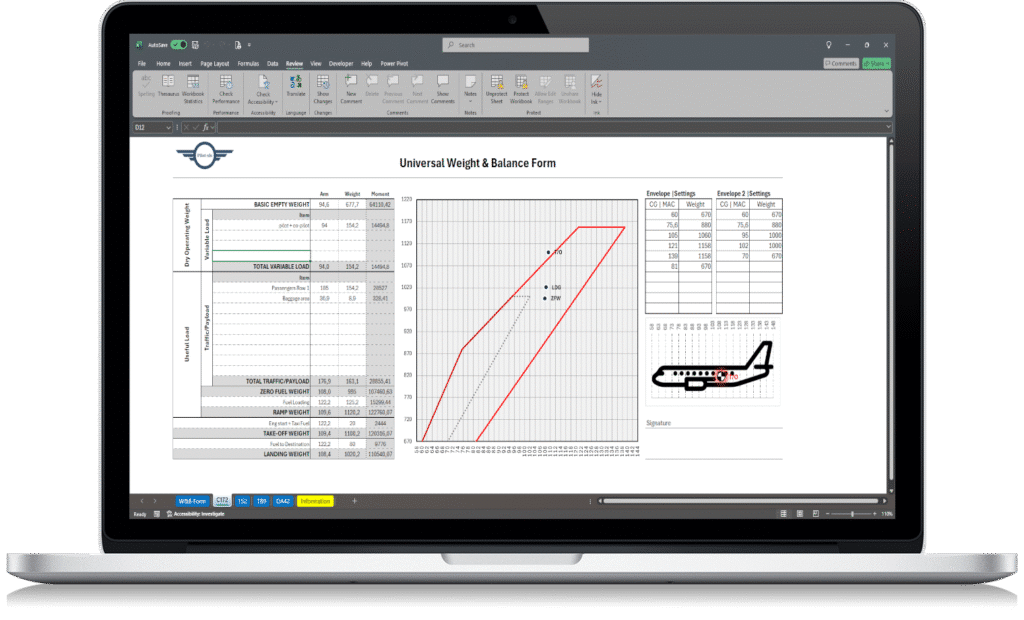
A good weight and balance excel should allow you to:
- enter passengers, baggage and fuel quickly,
- calculate CG instantly,
- check CG limits in real time,
- export a printable form for flight records.
Most online calculators are outdated or too generic, which leads many pilots to switch to customised digital tools.
Step-by-Step: How to Calculate Weight and Balance
1. Start with the Basic Empty Weight
Use the BEW and its associated moment.
2. Add crew and passengers
Each position has its own arm.
Weight × Arm = Moment.
3. Add baggage and cargo
Enter each compartment separately.
4. Add fuel
Don’t forget taxi fuel.
Convert litres or USG to kg when needed.
5. Calculate the totals
CG=Total MomentTotal WeightCG = \frac{\text{Total Moment}}{\text{Total Weight}}CG=Total WeightTotal Moment
6. Check the CG envelope
If the CG falls outside the permitted area, adjust the load immediately.
Never dispatch with an out-of-limits CG.
Common Mistakes Pilots Make
- Using outdated passenger standard weights
- Incorrect fuel unit conversions
- Forgetting to recalculate after a last-minute change
- Misreading the CG envelope
- Filling forms manually in a hurry
- Using templates not designed for their aircraft
Most of these issues disappear when using a structured digital tool.
The Excel Weight & Balance That Pilots Trust
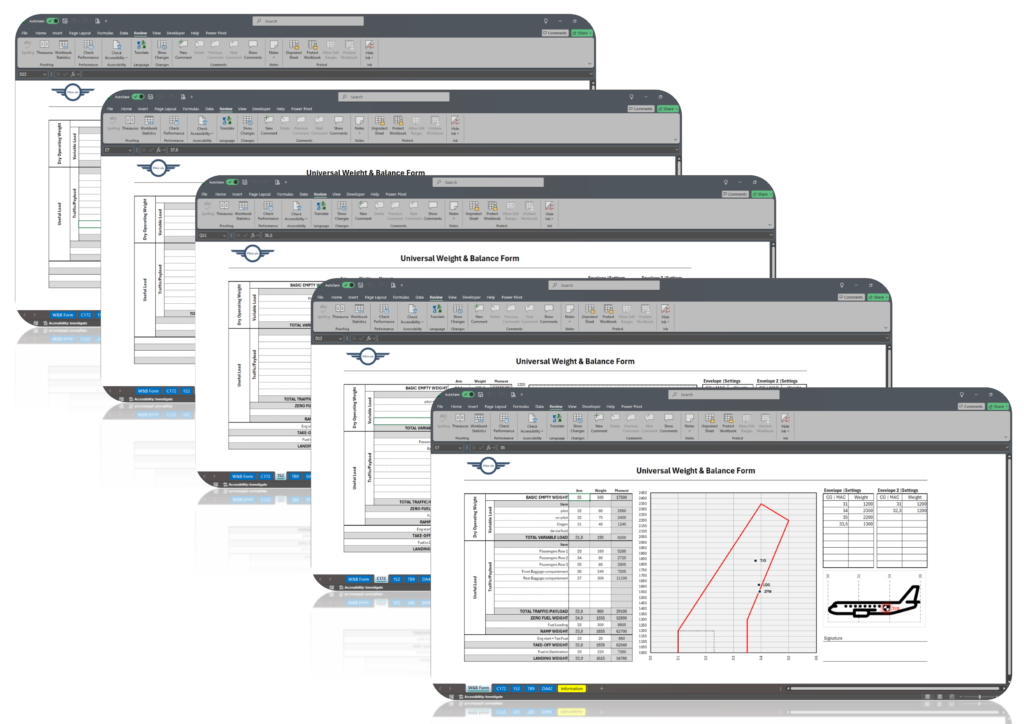
If you want a tool that:
- calculates Weight & Balance instantly,
- checks the CG envelope automatically,
- converts all fuel and weight units for you,
- produces a clean and professional weight and balance excel tool,
- reduces human error,
- and works perfectly on Windows, Mac or iPad…
Then you don’t need to build one yourself.
You can download the full Excel tool here:
👉 https://pilot-xls.com/product/weight-and-balance-spreadsheet/
This Weight & Balance spreadsheet is designed for real cockpit use, offering:
- accurate aviation-grade formulas,
- instant CG and limits validation,
- automatic moment calculations,
- fuel unit converter (kg, lbs, litres, USG),
- editable aircraft data,
- printable PDF output,
- a simple and fast workflow.
Whether you’re a student pilot, private pilot, instructor or commercial operator, this tool removes the stress of manual calculations.
Weight & Balance for EASA Pilots
Under EASA regulations, Mass and Balance documentation is mandatory before every flight. The completed form must reflect the actual load, confirm the aircraft remains within MTOW, and verify that the Centre of Gravity stays within the approved envelope throughout the flight.
This spreadsheet tool is structured to meet EASA Mass and Balance requirements, with fields for crew, passengers, baggage compartments, and fuel in both kg and litres — the standard units used across European operations.
Weight & Balance for FAA Pilots
Under FAA regulations (14 CFR Part 91), the pilot in command is responsible for ensuring the aircraft is loaded within its approved weight and CG limits before every flight. The FAA does not mandate a specific form, but requires that calculations are accurate and documented.
This Excel calculator follows standard FAA Weight & Balance methodology, supporting lbs and US gallons, and produces a clean record you can keep with your flight documentation.
Who Is This Tool For?
✔ Student pilots
✔ Private pilots
✔ Flight schools
✔ Instructors
✔ Charter and commercial operators
✔ Anyone who wants faster and safer pre-flight preparation
If accuracy and efficiency matter to you, this tool will transform your routine.
Ready to Simplify Your Weight & Balance?
Stop wasting time with outdated forms and calculators that don’t fit your aircraft.
Get your professional, ready-to-use Excel Weight & Balance excel tool here:
👉 https://pilot-xls.com/product/weight-and-balance-spreadsheet/
Make every flight safer, faster and worry-free.