When you apply for a pilot job, your flight hours matter.
Recruiters, operators and airlines often ask for specific totals: total time, PIC time, multi-engine time, night time, IFR time, time on type and sometimes even recent experience.
If your logbook is organised, answering those questions is simple.
If your records are spread across a paper logbook, notes, apps, screenshots and old files, preparing a job application can quickly become frustrating.
This guide explains how to prepare your pilot flight hours before filling in a CV, airline application or operator form.
Why flight hour totals matter in pilot applications
Flight hours are one of the first things employers check.
They help show your experience, background and suitability for a role. A company may ask for minimum totals before considering an application, especially for commercial pilot, instructor, corporate, charter or airline positions.
Common examples include:
- minimum total flight time;
- minimum PIC time;
- minimum multi-engine time;
- minimum night time;
- minimum IFR time;
- time on a specific aircraft type;
- recent experience;
- number of take-offs and landings.
Even when the exact requirements are not strict, clean flight hour totals make your application look more professional.
They also reduce the risk of mistakes when you copy numbers from your logbook into an online form.
Start with your total flight time
Your total flight time is usually the first number requested.
Before applying, check that your total time is up to date and consistent with your logbook entries.
Do not estimate unless the form specifically allows it. If an employer asks for flight hours, they expect numbers that you can support with your logbook.
A good habit is to keep a current total available at all times. That way, you are not calculating everything from zero whenever a new opportunity appears.
If your logbook is in Excel, this becomes easier because totals can be calculated from your entries instead of added manually.
Separate PIC, co-pilot and dual time
Total time is not enough.
Most job applications ask for more detailed categories, especially:
- PIC time;
- co-pilot time;
- dual time;
- instructor time, if relevant;
- pilot-in-command under supervision, if relevant.
These categories should not be mixed.
PIC time is often one of the most important numbers in an application. Co-pilot time may also be relevant, especially for multi-crew operations. Dual time can matter for training history, but it is usually treated differently from command time.
Before submitting an application, check that each category has been recorded consistently.
A small mistake in category totals can create confusion later, especially if your CV, application form and logbook do not match.
Check multi-engine and single-engine time
Many pilot jobs ask for multi-engine time.
This is especially common for commercial, airline, charter and corporate roles.
If you have flown both single-engine and multi-engine aircraft, your logbook should make it easy to separate those totals.
Useful categories include:
- total single-engine time;
- total multi-engine time;
- multi-engine PIC time;
- multi-engine co-pilot time;
- multi-engine IFR time, if relevant.
If your aircraft type or class is not recorded consistently, calculating these totals can take longer than expected.
For example, writing the same aircraft type in different ways across your logbook may make filtering less accurate. Keep aircraft names and type abbreviations consistent.
Prepare night and IFR totals
Night time and IFR time are often requested in pilot applications.
These numbers can be important for operators because they show experience in more specific operating conditions.
Before applying, check:
- total night time;
- night PIC time, if relevant;
- total IFR time;
- IFR PIC time, if relevant;
- recent night or IFR experience, if requested.
If you did not separate night or IFR time properly from the beginning, you may need to review individual flights to rebuild the totals.
That is why a structured logbook is useful. It keeps these categories visible instead of hiding them inside remarks or notes.
Review time on type
Some applications ask how many hours you have on a specific aircraft type.
This can apply to airline, business aviation, helicopter, instructor or specialised roles.
Examples of questions you may need to answer:
- How many hours do you have on this aircraft type?
- How many hours do you have on multi-engine aircraft?
- How many hours do you have on turbine aircraft?
- How many hours do you have on a specific aircraft registration?
- How many sectors have you completed on a type?
To make this easier, your logbook should use consistent aircraft type names.
If you record the same aircraft as “C172”, “Cessna 172” and “C-172”, filtering may give incomplete results. Choose one format and use it consistently.
Check recent experience
Some employers or operators may ask about recent experience.
This can include:
- hours flown in the last 90 days;
- hours flown in the last 6 months;
- hours flown in the last 12 months;
- recent take-offs and landings;
- recent night experience;
- recent IFR experience;
- recent time on type.
Recent experience can be difficult to calculate from a paper logbook, especially if you need to filter by date and category.
A spreadsheet-based logbook makes this easier because you can sort or filter records by date range.
Before applying, check the application instructions carefully. If they ask for recent experience, use the exact period requested.
Make your CV and application totals match
One common mistake is submitting different numbers in different places.
For example:
- CV says 1,250 total hours;
- application form says 1,270 total hours;
- logbook summary shows 1,263 hours.
Small differences can happen if your logbook has been updated after the CV was written, but unexplained inconsistencies do not look good.
Before sending an application, check that your:
- CV;
- application form;
- logbook summary;
- supporting documents;
all use the same date and the same totals.
A simple note such as “flight hours as of 15 March 2026” can help keep everything clear.
Avoid rounding problems
Some forms ask for hours in decimal format. Others may use hours and minutes.
Be careful when converting between the two.
For example:
- 1 hour 30 minutes = 1.5 hours;
- 1 hour 45 minutes = 1.75 hours;
- 1 hour 15 minutes = 1.25 hours.
Do not treat minutes as decimals directly.
For example, 1 hour 30 minutes is not 1.30 hours.
This is a common error when pilots manually prepare totals.
If your logbook calculates decimal hours automatically, check that the format matches what the employer asks for.
Keep supporting records ready
A job application may only ask for totals, but you should be ready to support those totals if needed.
Keep your logbook updated and backed up.
Useful supporting material may include:
- current logbook summary;
- scanned paper logbook pages, if relevant;
- training records;
- licence and ratings;
- medical certificate;
- previous operator records;
- simulator records, if relevant.
You may not need to send everything at the start, but having it organised saves time later.
How an Excel logbook helps with job applications
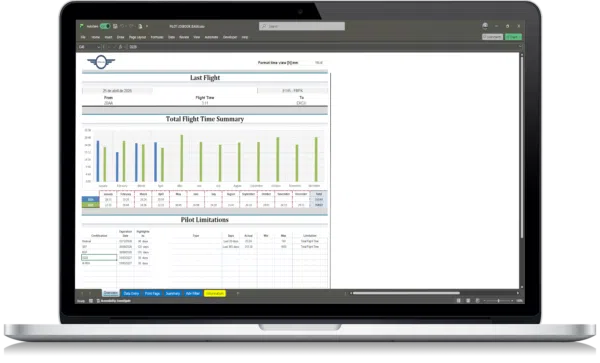
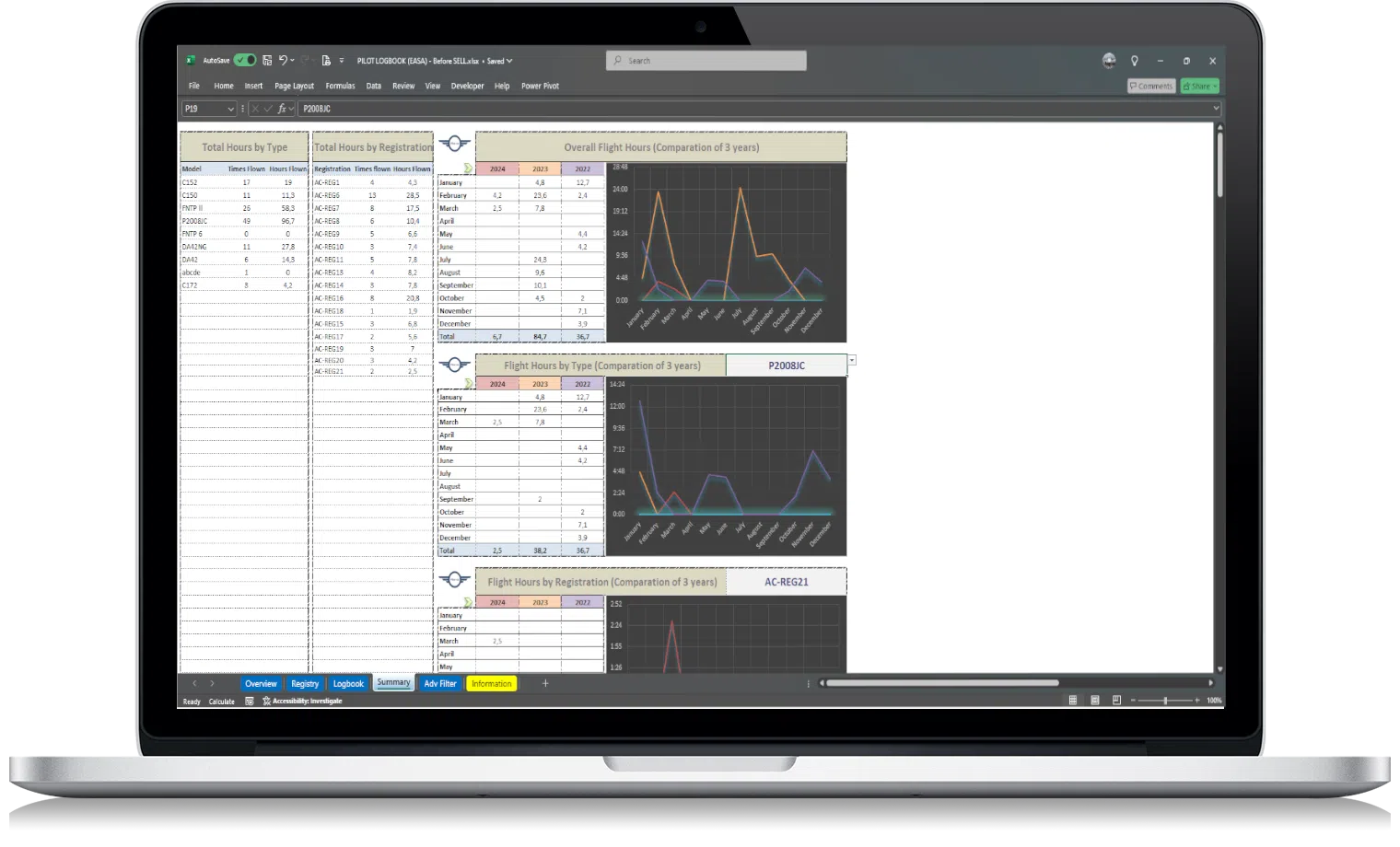
A structured Excel pilot logbook can make job applications easier because it lets you review and filter your flight records more quickly.
You can use it to check:
- total flight time;
- PIC time;
- co-pilot time;
- night time;
- IFR time;
- aircraft type totals;
- date ranges;
- recent experience;
- information needed for CVs and application forms.
Keeping your records organised in a pilot logbook for job applications can save time when updating your CV or completing airline application forms.
Use this internal link here:
pilot logbook for job applications
Final checklist before submitting a pilot job application
Before you submit your application, check the following:
- your total flight time is up to date;
- PIC time is separated correctly;
- co-pilot and dual time are not mixed;
- night time is calculated;
- IFR time is calculated;
- multi-engine time is separated, if relevant;
- time on type is consistent;
- recent experience is checked for the requested period;
- CV totals match application form totals;
- hours and minutes are converted correctly;
- your logbook is backed up;
- you can support the numbers if asked.
This does not need to be complicated, but it does need to be accurate.
A pilot job application is not the moment to discover that your logbook is disorganised. Keep your records clean now, and future applications become much easier.